

by Doug Hoelscher
(with information from historical documents)
When our ancestors emigrated from Europe to this new country this area of Ohio was a wilderness of forests and swampland. The first order of business was to clear trees and use the logs to build shelter for their families. Once they had cut enough trees to build a house, they usually had enough area cleared to plant a garden to supply them with food along with the game they hunted for meat. They were completely self sufficient, living off the land. They continued to clear land for farming, and eventually they could raise enough crops to support some horses and other livestock. The next requirement after supporting their families was to educate their children. Neighborhood schools were developed in crude log cabins, and often the schools were named for the family on whose land they were located. These schools were aptly described in the 1905 History of Western Ohio & Auglaize County by C. W. Williamson in this manner: “The schools, which were taught on the subscription plan, were only open one or two months a year. They were held in crude log buildings, and had furniture of the roughest description, slabs serving as seats, and a board placed against the wall was the only desk for the scholars to write upon.” Presumably, these schools operated on a limited schedule because the adults who were able to teach were also busy with establishing their homesteads and supporting their families, and the older children were needed at home to assist with family chores.
The village of Knoxville was laid out and established in 1836, and by 1840, enough people in the community were participating in worship services that a log cabin was built for worship services and another for a parsonage. These buildings were in the vicinity of the cemetery at the intersection of West South Street and South West Street. Late in 1841, a full-time minister was hired to replace a circuit rider minister. Thus, the new community was fully equipped for worship services, but they had no organized educational program for the children.
In late 1841, a 19-year-old man named F. H. W. Kuckherman, also known as Henry Kuck, came to Knoxville. He studied to become a licensed school teacher, and in the summer of 1842 he passed the test in Lima (the county seat of Allen County before Auglaize County was established in 1848), and became the community school teacher. He taught classes in the log cabin church building of the Reformed and Lutheran Church. In 1843 the Methodist congregation was founded in the community, and although the classes were conducted in the building belonging to the Reformed congregation, the eligibility of the students was not limited to members of that congregation. In the 1962 treatise written by Kuckherman’s great-grandson, Edwin Richard “E. R.” Kuck entitled “Biography of Reverend F. H. W. Kuckherman, Part I” we find the following facts taken from Kuckherman’s attendance records:
- The school was conducted in the Reformed Church built in 1840.
- Attendance was on a subscription basis. The tuition paid by the parents was 5 cents per pupil per day, making a full month’s attendance $1.00 per pupil.
- The school year was divided into two semesters of three months each. During the first term, covering October, November, and December, only German was taught. The term starting in January and lasting through March was devoted entirely to the study of English.
- The school day started at 8:00 A.M. and ended at 12:00 Noon.
- The first year’s attendance, starting in 1842, records the names of 13 pupils – all boys. The attendance for 1852 records the names of 27 pupils – all boys.
The following schedule was translated from the German and was the schedule of New Knoxville’s first schoolteacher, F. H. W. Kuckherman, and it is dated the 18th of January, 1845. (Obtained from Robert Kuck II, 1985)
Daily School Business (Schedule)
| Monday | 9-11 New Testament and German writing to 12 |
| Afternoon – Read Bible stories till 2 ½ (half of 3) | |
| 2 ½ Old Testament from then to writing Latin (our English script) | |
| Tuesday | Always as day before till 2 ½ o’clock |
| Reading and 1/2 writing | |
| Wednesday | Slate – writing using slates |
| Thursday | Reading. Writing. |
| Afternoon - Reading Bible stories (history) | |
| Write Bible stories on slates | |
| Friday | Same as Monday |
| Afternoon – Read hymns (Study) (Explain) | |
| Singing and questions (possibly catechism questions) | |
| 1/2 hour Latin writing (English) | |
| 1/2 for closing |
In 1852 F. H. W. Kuckherman was ordained as a Lutheran minister, and in order to avoid conflict between his congregation and the Methodist congregation, he encouraged the building of a community schoolhouse. In 1853 the Reformed congregation built a frame church building in the northwest corner of the intersection of Bremen and St. Marys streets, and they also constructed a school building adjacent to the church. In October of 1853 the new school opened with William H. Snethkamp as its first teacher. Evidently by this time or soon thereafter, the Washington Township government had some control over the educational system. Following is an image of a three-month Teacher’s Report filed with the township clerk in 1860. By this time there were 30 males and 21 females enrolled in the school. The report also recorded the number of students studying each subject.

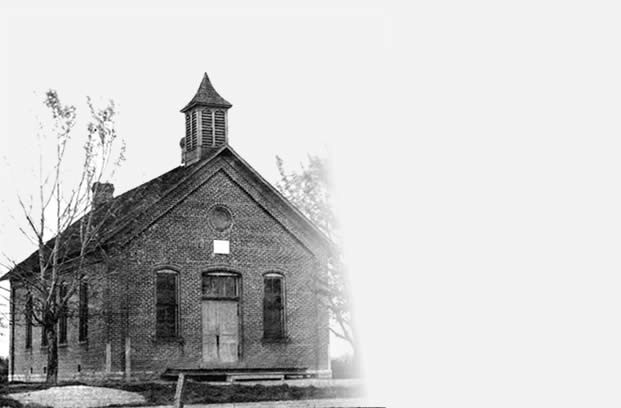
Meanwhile the country schools continued to improve. The old log cabin family schools gave way to frame buildings. Schools were located approximately every two miles so that theoretically no student had to travel more than a mile to school. The frame school buildings were replaced with brick buildings of which many remain today, some serving as residences. In most cases the schools were located on an acre of ground, which the farmer deeded to the township. After the schools were abandoned the land was sold, presumably in most cases going back to the original owner. Below is an image of a transfer deed from October 23, 1922, indicating that the Sunnyside school was sold at public auction to the highest bidder, that being George Henkener, the former owner of the property upon which the schoolhouse was situated.

WASHINGTON, ST. MARYS & VAN BUREN
TOWNSHIP SCHOOLS WITHIN THE
NEW KNOXVILLE SCHOOL DISTRICT
ST. MARYS TOWNSHIP, Auglaize County
Poppe School was located at 10990 Plattner Road. The building still exists and serves as a residence.
Carter Creek School was located in the southwest corner of the intersection of East Shelby Road and Carter Creek Road.
VAN BUREN TOWNSHIP, Shelby County
Sub-Dist. 1 – Silver Maple (Fledderjohn) School was located at 8252 Botkins Road in the northwest corner of the intersection with Fledderjohn Road. The building still exists.
Sub-Dist. 4 – Holtkamp (Woodland) School was located at 6021 Botkins Road in the northeast corner of the intersection with State Route 29. The building still exists and serves as a residence.
WASHINGTON TOWNSHIP, Auglaize County
Sub-Dist. 1 – Walnut Grove (Shinbone) School was located on the south side of State Route 219 across the road from address 11185. The building still exists.
Sub-Dist. 2 – Brookside (Hoelscher) School was located in the northwest corner of the intersection of State Route 219 and Bay Road.
Sub-Dist. 3 – N.K. Village School (Independent from township)
Sub-Dist. 4 – Cloverleaf (Lutterbeck) School was located on the north side of Cloverleaf Road a short distance west of Glynwood-New Knoxville Road.
Sub-Dist. 5 – Sunnyside (Henkener) School was located on the west side of Moulton-New Knoxville Road between addresses 11237 and 11729, across the road from 11400.
Sub-Dist. 6 – Owl Creek (Burk) School was located in the southeast corner of the intersection of Kohler Road and Owl Creek Road at address 11524. The building still exists and serves as a residence.
*Sub-Dist. 7 – Cleardale (Feil) School was located on the north side of Washington Pike between addresses 09209 and 09619.
Sub-Dist. 8 – Burroak (Stroh-Montgomery) School was located in the southwest corner of the intersection of Kettlersville Road and Burroak Road.
*Sub-Dist. 9 – Chapel School was located at 07361 Washington Pike. The building still exists and serves as a residence.
*Denotes schools located in Washington Township, but not in New Knoxville School District
NOTE: In many cases schools were originally named for the family who owned the adjacent land or lived near the school. Later the schools were assigned sub-district numbers by the township and in most cases were renamed, thus the dual names.

No high school program was offered in New Knoxville, so those individuals wanting to become licensed teachers or other professionals attended high school in surrounding communities such as Wapakoneta, St. Marys, or New Bremen. After Auglaize County was established in 1848, potential teachers could take the test at Wapakoneta, the county seat, to become licensed teachers. Some of these people became teachers as teenagers, and many individuals taught for several years in the country schools before starting another career. Others made a lifelong career of teaching.
The 1853 community school building located adjacent to the Reformed Church served the village of Knoxville/New Knoxville until 1885, when a new brick four room school building was erected on the north side of South Street between Mill Street and East Street at a cost of $5,000. At this point it should be noted that the name of Knoxville was changed to New Knoxville in 1858, when the village acquired a Post Office, due to the prior existence of another community named Knoxville in the state of Ohio.

The 1885 four-room schoolhouse on South Street
In the 1905 “History of Western Ohio and Auglaize County,” by Professor C. W. Williamson, he says about the New Knoxville and Washington Township school systems, "Although organized under the Union School law, the system of graded schools was not introduced (in that village) until 1885, at which time a four-room brick building was erected at a cost of $5,000." Continuing along this line, it is noted that "there are no schools in the county under a better system of management than the schools of Washington township. The board of education has always been liberal in the expenditure of money for school improvement. The Washington township board was the first one in the county to pay the tuition of the advanced pupils from the district schools and no township has sent larger numbers to the annual Boxwell examinations than this one. The nine school buildings are modern in their structure and in most instances are surrounded by beautiful lawns, ornamented with shade trees." The Boxwell examinations were administered in Wapakoneta to students to determine their eligibility to attend high school.
It was in the four room schoolhouse that New Knoxville’s first high school was established by Mr. George H. Kattman in 1908. This was a two year program, and the first high school class of ten students graduated in 1910. These graduates were as follows: Mrs. Caroline (Meckstroth) Holtkamp, Mrs. Bertha (Cook) Wellman, Mrs. Marianna (Wellman) Mayer, Mrs. Bertha (Duhme) Prueter, Noah Katterheinrich, William A. Stork, Rev. J. O. H. Meyer, Elmer Kruse, Gustave Schroer and Benjamin Feldwisch. Following the graduation of the class of 1910 the decision was immediately made to upgrade the high school program to a three year program, which it remained until 1926, when it was again upgraded to a four year program.
In 1914 classes were held in the town hall while the four room schoolhouse was razed to be replaced by a then modern fireproof brick building at a cost of $18,000, to which in 1926 was added a study hall, a gymnasium/auditorium and classrooms at a cost of $22,000. At this time a four year high school program was instituted. In the 1923 “History of Auglaize County”, the roster of teachers in the New Knoxville School is as follows: Edwin J. Meyerholtz, Paul Wenger, Elizabeth Kuck, F. A. Grewe, Selma Cook and Marianne Wellman.

The school building which served the community from 1914 to 1938 and later became the Hoge Brush Co. The building was dedicated on Friday October 16, 1914 with an afternoon program at the school.
As cars became the prevalent form of transportation, attendance in the village school increased with fewer students attending the township schools. As attendance decreased to levels that made the continuing operation of these country schools impractical, they were gradually phased out. We saw previously that the Sunnyside School was phased out in 1922 with the ground being deeded back to the previous landowner. We also know from a story entitled “I Remember” written by Mrs. Ruth Settlage Bambauer that the Cloverleaf School was dismantled following the 1928-29 school year. We have been told that the Brookside School was the last of the township schools to go, continuing to operate through the 1938-39 school year.
With the need for a larger and more modern facility and the opportunity to obtain approximately 45 percent funding from the federal government, the voters of the New Knoxville School District passed a bond issue for a new school in the November 2, 1937 general election. Immediately the Board of Education began the process of selecting a site to recommend. After viewing a half dozen sites, their recommendation was the old brickyard and the three lots in front of it facing State Route 54 (now Rt. 29). A mass public meeting was held, and the attendees of this meeting agreed with the recommendation of the School Board. Bids were approved, contracts let, and construction soon began.
The first classes were held in the new building September 19, 1938, with the dedication of the new facility held on November 12, 1938. With several additions and renovations, the building is still serving the community 85 years later.
NOTE: Detailed newspaper articles from 1937 and 1938 concerning site selection, construction bids, opening for classes, and dedication of the school can be viewed on our website.