

August 21, 1981
By Dean R. Hoge
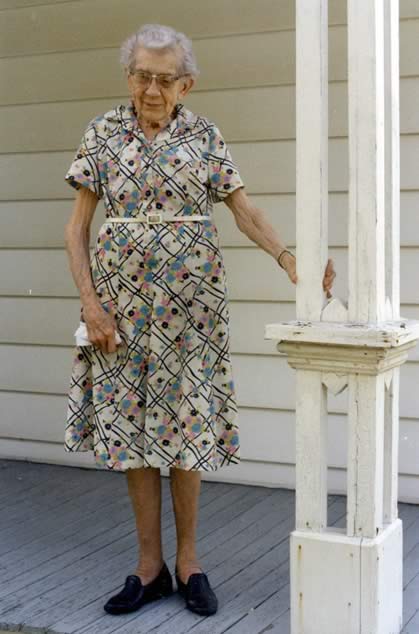
Zella Eversman
INTRODUCTION
This article is a transcription of a tape-recorded interview by Dean Hoge with Zella Eversman. He commented that he had some recorder and tape problems in the first ten percent of the interview. He said the problems began after the first few minutes and improved after a tape change. He also said that the tape broke during transcribing. He stated in a subsequent letter to Zella that accompanied the transcription that he was unsure of the spelling of some names, etc. He did the best he could with spelling of the Low German expressions so they could be sounded out. His original transcription was typewritten and double spaced with his questions and remarks in parentheses. His remarks about the interview and his tape problems are enclosed in brackets.
We have changed the format by separating their questions and statements to make the interview easier to read and understand. We have corrected the spelling of names to the best of our knowledge, and we have added some Editor’s notes in boxes to clarify locations, nicknames, etc.
LIFE OF ZELLA’S FATHER, DOCTOR FLEDDERJOHANN; HIS FAMILY AND EDUCATION. DR. ZUELCH’S HOUSE IN NEW KNOXVILLE. ZELLA’S MOTHER
DH:Let us begin with the life of your father, Doctor Fedderjohann. I assume he grew up here.
ZE:Yes, he was born where Willis Fledderjohann lives now.1 Near the big cemetery.2 And his father had buried a wife and two children with the cholera. Then Grandpa married a Wellman, related to Art Wellman’s father, and then Grandfather had two children left, Bill Fledderjohann—Dr. Ernst Fledderjohann’s father, and Mary Schroer—Schroers east of town. Grandfather to begin with had 6 children from the first wife, and there must have been two that died in infancy, because he had two left, and two died in the cholera. Then he moved eventually, and bought that farm at Lock 6; Tom Fledderjohann lives there now.3 Still in the Fledderjohann family.
|
Editor’s Note: |
DH:Between here and St. Marys.
ZE:Yes, between here and highway 66 going to New Bremen, near highway 219. That long, long
lane. And there, that woman had 12 children. Imagine. And Pop remembered, when he was little, that his mother said to him, shaking her head, she looked at him and said, “ach, do arme Heinchen, du wir doch so nieve nit geraut”—“You’ll never grow up.” And he lived to be almost 95, almost outlived the entire outfit.
DH:Which one of the 12 was he?
ZE:One of the early ones. I don’t know about the others, but I think he was probably the second or third maybe. There was another Henry before him. I’m sure it’s that far to the top. And he always liked Mary so well, the half sister of his. He told me that Mary really brought him up. You know, after his mother had more children, she was busy with the other ones. And as in all big families, the big children took care of the little ones. And so Mary, he said, dressed him in the morning, put him to bed at night, gave him his breakfast, saw that his needs in general were taken care of. He said that she really brought him up. So he always liked Mary. Her grandson is Enoch Schroer. They live across from the airport.
DH:Did he go to school here? Did he go to country school?
ZE:Yes, I suppose he went to the same country school that Uncle Ferd went to—Dr. Fledderjohann in New Bremen I guess. I’m not sure. Uncle Ferd remembered that he went to school right in that valley on the old New Bremen road, right at Tangeman’s where the barn burned—Louis Tangeman’s farm.1 Right down in that valley, down in there, there was the school building, just by that little bridge. But then he went to high school in New Bremen. I imagine walked the towpath, probably. Why he didn’t have a horse, I wouldn’t know. But he walked to school every day. Just followed the canal. That would bring him not too far from the school.
| Editor’s Note: 1 08573 New Bremen-New Knoxville Road. |
DH:Why did he become a doctor?
ZE:I don’t know. I have no idea what prompted him to do that. He first was a workman. His father built the sawmill there at Lock 6, you see, so Pop was a sawmill man. He was always interested in woods—what kind of wood this was or that was.
DH:Water-powered sawmill?
ZE:Yes, at the lock. That’s why Grandfather bought that particular farm, because of the lock. My grandfather didn’t really farm; he operated that sawmill. Then Dad taught school. Then they didn’t even have to go to college to teach school. But they did, most of them, they went to some college, for a year or so. Then he went to medical school at the University of Pennsylvania. Only three years, then he was a doctor.
DH:No undergraduate school, then medical school?
ZE:Three years in all. That’s all he had. He graduated in 1886. [inaudible] Then he was a doctor in St. Marys for a few years, and then got married and moved to this place in New Knoxville.
[The next few minutes are barely audible. Talked about his marriage, building the house in New Knoxville. Zella was ten months old when her mother died of tuberculosis. Zella was reared largely by
her grandmother Snethkamp until she was six years old, then she moved to her father’s house in town. He hired a housekeeper.]
ZE:My mother liked artistic things. They told me that my mother was a “lady.” They could see that my mother was a lady. There was no one around here who could wear clothes like she. Nor sew them. Nor design them. My mother was born in Indianapolis. Grandpa Snethkamp went to Heidelberg College. He was a schoolteacher. He didn’t like farming. He liked books though. [inaudible] So he went to college and became a schoolteacher, and he taught in Indianapolis. Later he moved to St. Marys, and made his living again being a teacher, notary public, and writing oil leases. He had some quirks. [inaudible]
DH:So your father spent his entire career here.
ZE:Yes, except for a few years at St. Marys. He bought this house first, then he built the office. I would like to know exactly when this house was built. The doctor that was here was a Dr. Zuelch. He married a Schroer. [inaudible—changed tape]
DH:So, to repeat, Dr. Zuelch built this house.
ZE:He built this house. Now, I want to know when this house was built.
DH:Was your father in competition with this Dr. Zuelch?
ZE:No. Pop was in St. Marys, and Dr. Zuelch must have been here. Then he wanted to move to Denver. I don’t know why, whether for health reasons, I don’t know. You wouldn’t think that a doctor would build a house—and his office was in this front room—and live in it two years? You would hardly do that. So he must have lived in it three, four, or five years, you would think. So then Pop got it on the 4th of July 1888. So I figure the house must have been built around ’83, at least around then. That’s 98 years ago.
DH:So the house was here, and your father built that office.
ZE:Yes. And there’s one remembrance that I have of my mother. My mother planted those vines. That’s why we always kept those so nice. He always said, that’s one remembrance that you have of your mother, and we want to be sure to keep good care of those. And they’re still growing on the office.
DH:So how many years was your father and mother married before she died?
ZE:’88 to ’97. Nine years.
HIS PRACTICE AS PHYSICIAN; OPERATIONS; NEW MEDICINE FOR POISON IVY AND GOITER
DH:So then he was the only doctor in town, right?
ZE:Yes.
DH:Was there a hospital, or what did he do when he needed….
ZE:They didn’t have hospitals. He operated over there.
DH:He operated right there?
ZE:Yes, right there in the office—in the next room. And in houses, on kitchen tables, by kerosene lantern. He did a lot of operating on tables. Pop didn’t like to operate. He was not a surgeon; he didn’t pretend to be a surgeon. But he apparently did good work. And he did a lot of operating on kitchen tables.
DH:Did he even do things like take out appendixes and all that?
ZE:Yes.
DH:Caesarean births—did he do all that?
ZE:Did those too. And then one day he and Dr. Dine of Minster, another Low German Minster doctor—Dr. Dine and he were discussing not having any trouble with infections in births. And of course it was all very primitive. But they were not having any trouble with infection. Dr. Dine asked Pop, Do you have any trouble with that? Pop said, No, he didn’t have any trouble with that. Dr. Dine said, To what do you attribute that? My own policy is—Halt dine verdammpte klauen rein. “Keep your damned claws clean.”
DH:Is that right.
ZE:He said, that was the whole thing—to prevent infection. You know how much infection they used to have, because of uncleanliness. That was the secret of it. “Keep your hands clean.” Dr. Dine said that to Pop. Pop said, “Yes, I do too. I wash with green soap and very carefully.” Pop did not have trouble with infections and things like that.
DH:Did he invent his own medicine?
ZE:Yes. He read a lot. For instance, I am right now trying to coax this woman doctor at Tipp City to see whether she will give me these medicines. I haven’t been able to get them. I can get them from London, but why should I send to London if I can get them here. And they are in this country.
DH:Now, you’re talking about ivy poison medicine.
ZE:Yes, that one. And any kind of homeopathic things. Now, Pop read up on ivy poison. He didn’t know how to cure ivy poison—he just read and read, late at night, when there were no people here. There were no office hours of course; you could come any time. But most people went to bed early. And he didn’t have patients later than, let’s say, ten o’clock (laugh), and then only some fellows came to play cards or something like that after ten o’clock. But he read a lot. And that’s how he also studied up on goiters.
DH:Goiters, was that a big problem?
ZE:Yes, it is. Nowadays, you see, you take them out. But he did it without operating. He didn’t operate on them. And during World War II, when alcohol was to be distributed so carefully, and you had to lock it up, and so on and so on, in order to get your portion of it—so then an inspector came here, who came from Columbus, and said he was living out here at the lake for the summer. And he came here to see what Pop would want that alcohol for, and so on. And we had patented this ivy poison medicine, and goiter medicine, and cold medicine.
DH:So he had his own patents?
ZE:We did have those patented, yes. The patents have all run out by now. And this man said, “Oh, you say you make a medicine for goiter?” “Yes.” “When you get that finished, you let me know, because my wife has a goiter, and she’ll want to try some of that.” “Oh,” Pop said, “You don’t have to wait. I’ve been doing this for years. I’ve got that right now.” “You have? Then give me some. My wife has a goiter, quite a sizeable one, and they want to operate, and she’s deathly afraid of the knife. She does not want the operation.” So he took the medicine home right that first day. About two weeks later he was back, and said, “I can’t tell if that medicine helped one bit, but my wife says it did. The goiter is just as big as it ever was; I see no difference whatever. But she says that feeling of apprehension—that worry, that butterflies in her stomach all the time—always that crawly, crawly feeling; that is gone, that nervousness. She feels much more at ease. I want some more of it.” He got another bottle. Two weeks later he was back. “I can see it now. It’s going down.” And that kept on. Another two weeks he was back, and said, “Oh, she feels so much better! You know, that thing is almost gone.” And he got another bottle. And later on he came, and he wanted another bottle. And he said the thing is all gone now. “But,” he said, “I want another bottle of that medicine, just in case. I want to kill the damn thing. But she’s fine.” Now, if she had gotten that again, you know, he would have been back. Because he knew where we were. And he was here all these years. Pop never saw the man again. He was just here for that period of World War II when they had to be so careful of all those things, that you wouldn’t get more alcohol than was your portion. And Pop had to show him where he kept it under lock and key.
DH:So, how long was your father active as a doctor?
ZE:Over fifty years. From the summer of ’86 to—I don’t know how long. But then, you see, even after he really shut up the office, he still worked from the house here. The drugs were in there, but people would still come over here.
DH:Even after World War II, he was still active, then.
ZE:Oh yes, un huh.
DH:How long did he live?
ZE:He died in 1950. People still ask me, “Do you know what your Pop did for so-and-so? Could you give me that?” A woman came here—the woman lives in town here—and they had been from one doctor to another; they could not find any cure for what ailed her. Pop was in the house here, he wasn’t doctoring any more. And he said, Yeah, he believed he knew what to do for that. So he got up and went to the office and fixed up her medicine, and gave her some. She took it for a while. Gone! And then years later she came to me and said, “Do you know what your dad gave me for that? All these years I’ve been rid of it, but now I’m getting it again.”
ZELLA’S CHILDHOOD AND SCHOOLING; EARLY INTEREST IN MUSIC; FIRST PIANO LESSONS
DH:How many are in your family? How many brothers and sisters do you have?
ZE:I had two sisters and two brothers. The one sister and one brother died in infancy, and then my sister died in 1961, and my brother in 1962.
DH:So you were five.
ZE:Five.
DH:And you lived here.
ZE:Yes, I lived here except for the almost six years that I lived with my grandmother, then I lived two years in Chicago, and six years in South Dakota.
DH:Did you go to high school in New Bremen also?
ZE:Yes.
DH:How did you get to school?
ZE:They took me on Monday morning, and I came home on Friday evenings. I lived with Mrs. Heil. Did you know—you don’t, you didn’t go there—Norma Schulenberg, and Letha Rider, and those. I lived there. When you leave the drug store in New Bremen to go to Minster, southward, three doors to your left there are two steeples, two towers, up there. That’s where I lived. Sometimes I slept in that very room.
DH:There was an arcade in that block, wasn’t there?
ZE:No, the arcade is on the next corner. But this is only about three or four doors from the street. A loan company is right there now. Right next to that loan company, that’s where I lived. Mrs. Heil had a restaurant, and she baked bread. And I lived there for four years.
DH:Did you know you would be a musician so early on, or was that later?
ZE:I always liked it, yes. I had twelve lessons—you had more than that—I had twelve lessons from Flora Bachman.
DH:Who was she?
ZE:She was our minister’s daughter—Preacher Bachman.
DH:Oh ya.
ZE:She taught my sister. She taught my sister all she could teach her—so you know how proficient she must have been! Anyway, then she taught me that. And I had twelve lessons from her. Then she got married, I got a new dress, and that was the end of my musical career.
DH:Is that right.
ZE:Then I just tried, and asked my sister, if I got stuck, I’d ask her, how to do this, how to do that. So I played. And then I played for catechism on a pump organ in the prayer room there. And then I went to high school and I played for everything in our class, and then I was—
DH:With only twelve lessons.
ZE:Yeah. See, I liked it, and I always rather thought I would like to play the harp. But I never got to. Besides we didn’t have the money to give me the education anyhow. Now, Esther Holtkamp, after Flora Bachman was married and left, she went to Emma Wellman for lessons. Why they wouldn’t send me there, I don’t know.
DH:Was Emma an accomplished pianist?
ZE:No, but she was a piano teacher (laugh). And I never went there. No one ever gave me any more lessons than that! I just had my twelve lessons with Flora. And then…after I was out of high school, then Ferd insisted, he thought that I had talent—he thought I ought to have some more lessons.
DH:Was he your boyfriend, or what?
ZE:Well, everybody thought he was my sister’s boyfriend, I guess. And he wanted to sing. And he needed an accompanist. So he called up over here and he asked Fran whether she would play for him if he’d come over. And so he came over here, and she played for him. She had to stay here—she couldn’t go anywhere else—because our housekeeper was sick; she had gallstones. Ya, we operated on her in the dining room over there, in 1912.
HER FATHER’S SECOND-WIFE-TO-BE; HOUSEKEEPER; HOUSEKEEPER’S DEATH
DH:So your father never remarried, then.
ZE:No.
DH:You never had a stepmother.
ZE:No. He would have married, I’m sure, but the girl he was going to marry was a daughter of a Methodist preacher that was here years ago. And she was a teacher at a suburb of Cleveland. Collinwood—that’s the name of it. She was a teacher there. And they had a big, big fire. And she went in to be sure that all her children got out, and she didn’t get out. The children did, but she didn’t. She burned in that fire. If she’d stayed out, it would have been all right. But she went in. And so he never married. And we had a housekeeper all that time, the same housekeeper who was here when I came home, died then in 1912. And my sister and I helped with the operation, right here in the dining room, on, I think, the table. Though. We got the operating table from the office, and put that in the room. We had to take the carpet out, the rugs, and wash everything, and scrub the floor and woodwork and everything.
There was a case—they used to say it as a joke—“The operation was a success, but the patient died of the shock.” And that’s exactly what happened. She was too fat, for one thing. I was amazed when they cut her open, and I watched that, fascinated. And the layer of fat—that thick! (Six inches thick.) Oh, disgusting. (laugh) And then, when I saw that—she had just too much fat around the heart. Couldn’t take it. Otherwise the operation was all right. That was a case, too, where the patient died of a shock.
PIANO LESSONS FROM THE KAISER SISTERS; THE KAISER GIRLS; EATING TURKEY; PIANOS AND REED ORGANS IN TOWN
DH:So, when you finished at New Bremen High School, then you….
ZE:Came back home here.
DH:And then your music career came after that?
ZE:Then I went to Wapak and took lessons, Esther Holtkamp, and I, and Alice Kuck—we went to Wapak. We would drive a horse, either Esther Holtkamp’s horse, or Alice’s horse. We would drive to Moulton and leave the horse there at Moulton, and take the streetcar from Moulton store there, on Friday mornings, and take a lesson at the Kaiser girls. Emma Kaiser.
DH:Who were they?
ZE:They were Germans. Very strict Germans. Very, very “German” Germans.
DH:They were from Germany?
ZE:Yes, they were. They were in a bit of trouble during the first world war, because they bought German war bonds.
DH:Oh, they did?
ZE:Yes. That didn’t look too good. Ya, they were in a little bit of trouble there. (laugh) But they were good musicians. The one was a pianist and the other was a violinist and a pianist. But she didn’t teach as advanced work as the other one did.
DH:I see. So they were learned from Germany.
ZE:Yes. The piano teacher was the one that I had. She told me that she had played in concert when she was six years old, and she was quite gifted. She had played then, and she had had a glissando on the piano, and she ran that up there, and the people were fascinated that she could do that, and they applauded and applauded. And they insisted that she play the piece again. And her fingernails were very thin, very thin. I noticed that when she worked with me—what fancy little fingernails she had. And the fingernails bled when she got through.
DH:Is that right.
ZE:Such tender fingernails…. But she was very gifted.
DH:So why would an accomplished musician like that be in a rather rough place like Wapakoneta, Ohio?
ZE:Well, you mean why they weren’t in some university or some big conservatory? Well, I don’t know. Their brother was a druggist, a very well-known druggist. And he used to come to our house quite a lot. They used to hunt rabbits and squirrels…and whatever was around here. And that was one of the three times a year when we all had turkey. Other people never ate turkey around here.
DH:Wild turkey?
ZE:No, not wild turkey—domestic, tame turkey. Our first turkey we usually had in the fall, during the hunting season. Then this druggist Kaiser, Wilhelm Kaiser, and a couple of doctors, and a newspaper man I think it was—Dr. Nichols, that was the doctor—they would come over here with their hounds, and they’d put the hounds in the summer kitchen, pen ’em up—and they’d yelp from there, and then we always had a big turkey dinner. That was our opening one. And then we’d eat the rest of it after they were gone. Then we’d have another one at Thanksgiving. And another one at Christmas. Those were the three times we had turkey. (laugh) But other people said they didn’t like turkey. Pop always told them, “You will if my housekeeper fixes them—they’re not dry.”
DH:If you went to Wapakoneta for piano, that assumes that there was no one here in town who knew very much.
ZE:No, I guess there was no one here any more.
DH:Did the church have a pianist, or organist, or how did they do that?
ZE:Oh, I don’t know…. Oh, lots of people played the piano of a sort. They all played reed organs, you see. Not pianos much. They had reed organs. When I took my first lessons I took them on a reed organ too, right here.
DH:That was more common than piano, I suppose.
ZE:Yes. Uh huh. People didn’t have pianos. A piano was a rare thing.
CHURCH ORGAN; EARLY ORGANISTS
DH:So the church also had a reed organ then, or did they have a big pipe organ?
ZE:No. well, the church got a pipe organ in 1895…I believe. Wait a minute…it was built first in ’93. So it must have been dedicated around ’95. Then they must have gotten the organ a few years later. And it was—the big one—it was upstairs above the clock. And that was hand-pumped, of course. And then old Herman Holtkamp, I guess it was, was the first organist. Then later Theodore Clausing, over here—Herbert Holl’s grandfather. And then Henry Holtkamp and Herbert Holl.
KAISER SISTERS; FARMER’S INSTITUTES; FERD’S TRAINING IN MUSIC; YEARS AT BUSH CONSERVATORY; MUSICIANS IN NEW KNOXVILLE; JOB IN SOUTH DAKOTA
DH:But you’re saying that nobody was as accomplished as the Kaiser sisters.
ZE:No. They were the best thing around anywhere. Even to Lima, I’m sure they were the best. And they gave concerts and so forth. They were hired by the committees for farmers’ institutes, which we used to have.
DH:What are those?
ZE:They were studies in modern farming. They had farming people come to speak, from the state—that sort of thing. And then they had entertainment. They would have a male quartet, which went over big all the time. They always do. And then one night they would have a home talent play. And…oh, they would then have another theatrical company come in from somewhere, and then the Kaiser girls would give a concert here, that sort of thing. So they were quite accomplished. So they made money doing that, and they played in church, too, you see. The pianists were also church organists. They were busy. And they had a lot of pupils, they had a lot of people from Wapak. Then Ferd insisted that I go take piano there.
DH:Were you married to Ferd then?
ZE:No.
DH:Well, how did he insist?
ZE:Well, he still came over here. My sister played for him. And then I played for him too, you see, after I was out of high school. See, I would come home on weekends. That’s how he would see me then on weekends. That’s when he thought that I had more talent than my sister—I should take some more piano. So he insisted on that, so then I went to Wapak and took piano there. And then he went to the army. And after he came out of the army, then we were married that fall. But he wrote to Chicago to the school—
DH:So you were married at about 18 or 19.
ZE:No, 23. We were married on the 9th day of 1919, of the 9th month, at 9 o’clock in the morning. (laugh) And a year later when we came home to visit, Reinhart Kucks’ were over here at Mother’s to visit us, and they said they had been married on that day, and they had picked that day because of that, because of the 9’s. The 9th day of the 9th month of 1919. Well, we said, we can go you one better. You weren’t married at 9 in the morning. (laugh) We said, we didn’t even pick that because of that. We picked it because that’s when school began in Chicago. That’s when the semester began. And that suited us best to be married. Ferd already wrote to them in the summer that he and “Mrs. Eversman” would be there at such and such a time. And we were.
DH:Did he have musical training before you were married?
ZE:Yes.
DH:Did he go to some kind of a college?
ZE:He went to Heidelberg, and he went to Marion, Indiana, to a Normal School, to Muncie, which is now Ball State—it was Muncie Normal Institute then—and he took from the Kaiser girls at Wapak.
DH:Did he study piano, or voice?
ZE:Piano. Then voice he picked up later, you see. That was when he went to college. So then he told them at school in Chicago that he and his wife would be there. Otherwise they’d know we were newlyweds. So we went there, and went to the school office the very day after we were married, and then one of the fellows said to him—one of his good friends who had been there before….
DH:Which school did you attend?
ZE:Bush. It was called Bush Temple then. Bush Conservatory. It’s Chicago Conservatory now. They merged with a school downtown. And then this friend of his said, “Oh, did you marry that girl you had here last summer?” Ferd said, “Yes, uh huh.” When a summer or two before that, when he graduated from some kind of a thing—he had attended Bush before—then Mother and I were going. For some reason or other Mother couldn’t go at the last minute. She insisted that I go to Chicago with him alone.
DH:Is that right. Wasn’t that unusual?
ZE:Yes. I told her I didn’t think I’d better do that. “Yes, you just go.”
DH:Is that right.
ZE:So I did. So then, you see, then these people met me there. So I had been at this school before. So then we came back and the friend said, “Did you marry that girl you had here last summer?” “Yes.” So then after a while, at the end of the year, then people asked us about when we were married, and so on, then we told them that we were married the day before we came. “What? Really? If we had known that!” We thought of that. Ferd said, that’s why I wrote to the school in the summer, to tell them that my wife and I would be there.
DH:So he always was a student of music then, from the very beginning.
ZE:Yes, Uh huh.
DH:He always tried to have a career in music.
ZE:All the time, yes. All his youth.
DH:And he grew up right here in town too, right?
ZE:Not in town, he grew up north of town, where—about the last house before you get to Stop 30 road.1 It’s Henschen now.2 That’s where Ferd grew up. On the right side. He was born over there in Shelby County. He was born a girl—so the records say. (laugh) He was a girl. They had to have that corrected.
|
Editor’s note: |
DH:Were there other musicians in town? Were there accomplished musicians here earlier?
ZE:I wouldn’t say so, no. He wasn’t so accomplished in those days either! Neither was I.
DH:Were there people who had studied in music schools?
ZE:No. Alice Stub,1 you know, who teaches. She’s never studied anywhere but the Kaiser girls.
|
Editor’s note: |
DH:But Ferd had been to college, and then you both went to Bush.
ZE:Yes. Then he put me through school, you see. See, he went on the veteran’s program. And then he worked as a barber in off hours—at suppertime and at noon time. Just when other people went out to eat, that’s when he worked. And then we lived off of that.
DH:You did?
ZE:Uh huh, and then I went to school—he got his tuition and stuff, and then with the extra money that we could make, with that he put me through school.
DH:So you both studied music, then.
ZE:Yes. That’s all we did. We got our degrees.
DH:So you had two years at Bush.
ZE:Well, more than two years. I studied in summertime, too, and then crammed it. I took one whole year’s work in one summer, with a whole lot of nuns. I was the only one in the class who wasn’t a nun. They would come back for refresher courses.
DH:Was that a Catholic school?
ZE:No, it wasn’t. They would just come from all over, all over the country. So I went in that class too. And when I got back from that class—they were an hour and a half long—that’s concentrated work—they had had it! They were old women already, they were in their fifties and sixties, having refresher courses. And there I was, 23 years old, never having had that. I worked so hard! And Ferd said, (laugh) “Leave it to you. You wouldn’t let those nuns get ahead of you.” I used to come home, throw my books down, collapse on the bed spread-eagle and just lie there and melt. I was so exhausted from thinking. (laugh) But I crammed it in.
DH:Were you studying music education, or studying piano, or composing, or what did you study?
ZE:I studied piano, I studied voice, I’ve even done a little voice teaching, because people insisted on it. I didn’t want to, but one of the girls here said, “When you, when Ferd would sit there, you’d sit and play for us. And when I sang or someone else sang, you’d say, ‘That needs a little more so-and-so, doesn’t it?’ and he’d say, ‘Yes.’ You could tell him what was needed! You knew it. He knew it. Why can’t you do it for me now?” So I did. I did some voice teaching.
DH:So when did you finish at Bush?
ZE:In 1921. I only went in ’19. See, I studied summers through and everything. Just took a week or two off, otherwise I worked all that time.
DH:What did you do then?
ZE:Then we got our first job in South Dakota, at a teacher’s college. One of our professors in Chicago said, “Is that where you’re going? You’re going to love it there! You’ll love the people. I go there—I’ve been there several times. That’s a musical town.”
DH:Which town was it?
ZE:Madison, South Dakota. He said, “I’ve been there.” They would have chautauquas. They also used to have chautauquas here. They were a week or ten days long.
CHAUTAUQUAS IN NEARBY TOWNS
DH:I don’t even know what chautauquas are.
ZE:They are entertainment for small places, who cannot go to Boston or New York to get their culture. In the morning you have a lecture. In the afternoon you have a…oh, let us say, maybe a comedy. In the evening you’ll have a big band. All right, keep that up for ten days. Morning, afternoon, evening.
DH:Some kind of a troupe would come through?
ZE:They would come through in tents. They had it in a tent. Bremen had it, Wapak had it, St. Marys had it. And we would buy tickets for them, drive over there with a horse and buggy, and morning, afternoon, and evening, for ten solid days. Bringing culture.
DH:You’d got to all of them, or just to a few of them?
ZE:We’d drive over there and listen to it, at Bremen.
DH:I didn’t know that.
ZE:Oh,…I remember some of them. Grace Ende—you know who she is, Elmer Ende’s wife—Grace Boesel—Grace Ende’s sister, who now lives with her I think, she met a man at New Bremen, when she was young, he was there in some kind of an organization, I think, of singers. I don’t remember. But he was there, it had to do with a chautauqua. She met this fellow and married him.
DH:Is that right.
ZE:And she is now a widow, living back here in New Bremen with Grace. But she met that man there.
ATTITUDES TOWARD CARD-PLAYING; CUTTING GRANDPA SNETHKAMP’S HAIR
DH:Was there ever a feeling in New Knoxville that going to theatrical things was sinful or bad? Or dramas?
ZE:Way, way back, yes. But not in those days anymore. But way back. Dancing was very evil. (laugh) On the pulpit, how Kunst would pound that pulpit! And card playing was bad. Mother to her dying day did not want regular playing cards in her house.
DH:Is that right.
ZE:She saw us play cards here. And Janie had her own deck—Janet, my little crippled girl, you know—she had her own card deck. But that was all right. She didn’t know what it was about anyway. And Pop sat and played solitaire and played cards here. But Mother didn’t want them there.
DH:That was Ferd’s mother?
ZE:Ya. I called her Mother; she was the only mother I ever had.
Ferd used to say to me, “You know, I have the feeling that I have to be extra good to you—extra nice, because you didn’t have a mother.” “Ha! I didn’t have a mother?” I said, “You think I lacked mother love?” “Uh huh.” I said, “I had more mother love than any two children combined, that you can name. I was spoiled rotten! My grandmother, my grandfather, my aunts and uncles, all spoiled me. They thought I could do no wrong. They loved me to pieces, and so did the neighbors. I didn’t lack mother love. I had more than most four children combined.” (laugh)
Ferd told this story. My grandpa, as I said, didn’t like to do physical labor. He didn’t like to hitch up a horse and go to St. Marys either. He only lived a mile from town.
DH:Why not?
ZE:Why, he didn’t have to do that; he could ride with somebody else! He could recognize, sitting out on the lawn in a rocking chair, he could recognize the horses’ hoofs on that bridge. He knew practically who that was coming, he was so familiar with all those horses. And one day Henry Eversman and Ferd came there on a spring wagon. So he went to the street to pick up a ride to go to town with them. And Henry Eversman said, “Uncle Snethkamp, what’s the matter with your hair?” And my Grandpa Snethkamp had a big bristly head of hair—to his dying day. “Oh,” he said, “the little girl cut it. I’m going to town now, to have it fixed.” I know that I did this. I can see myself doing it. He would sit on a straight chair backwards, put his arms over the back of the chair, lay his head on his arms, I would pull up a chair right by that, climb up there with scissors, and I’d give him a haircut. Now why? Why did they let me do that? I don’t think I could have thought of that. I don’t know why I did it. But why did they let me do it? It certainly wasn’t cruel to tell me that I couldn’t do that. That wouldn’t lack “mother love” would it? I don’t understand. But I’d just go in and chop away at that. And then of course he looked a mess. And then Henry said, “Onkel Snethkamp, Wat ist dat mit dien hoar?” “Lütke Wicht haf dat doan.” Then he’d go to town to the barber shop and have it straightened out. And then he’d find somebody else who was going back, and he’d go home with them. Or maybe Henry Eversman told him that he’d be back and pick him up—you can’t tell. He didn’t like to bother with that.
GRANDFATHER SNETHKAMP
DH:You said he was some kind of an eccentric. Was he an eccentric person?
ZE:I think he was. So am I, for that matter. I know that I am.
DH:How did he make his living?
ZE:Uh, mostly by oil leases and things like that. And he was a teacher for many years, a school teacher. I have some of his records here yet. And as I say, he actually was out of Heidelberg. He didn’t graduate from Heidelberg. But he went two years. And then he went to Indiana and taught. And then he taught around here. And then in later years he was a notary public, stuff like that. And he had an implement store here, kitty corner across from the church, where John Kuck lives now, in that corner house.1 There was a big building there, and he had an implement store in there. And that sort of thing. And then they lived on the farm. He never farmed; grandma did the farming. And the land was all rented out. And they had oil wells. So that’s what he did—he did oil well stuff. He wrote leases; he would go to Indiana. He went to Legota, Indiana. And I wanted to know where Legota was, so they told me “Over there,” you know.
|
Editor’s note: |
RETURNED FROM SOUTH DAKOTA; FERD’S MUSIC TEACHING; DOC FLEDDERJOHANN AND FRED GREWE IN LADBERGEN
DH:I’m interested in your own career. You were in South Dakota a while, then you decided to come back here.
ZE:Six years in South Dakota. We didn’t decide to come back, but Mother did.
DH:That is, Ferd’s mother.
ZE:Yes. Mother wrote us that Pop couldn’t stay alone any more. He was getting too old to stay alone, that we’d have to come back. And my sister, she was a preacher’s wife, she couldn’t come back. So it was up to us to come back. We came back and didn’t even have a job. Simply came back. And then that first year Ferd didn’t have a job. He just advertised in the paper, then, and got voice pupils. He had taught in St. Marys before, years ago already, you see, so he was known there. So then he went to voice teaching again. And then the next year he got a job; he was the head of the Music Department in Findlay College. See, that wasn’t too far away—60 miles away. He was there for a couple of years.
DH:But you stayed here.
ZE:I stayed here. With Pop, you see. And the children stayed here. He didn’t like the driving all the time, and being gone all week and coming back on weekends.
DH:Wait a minute—which father did you come here to care for?
ZE:My Pop. Doctor. See, he lived here all this time, from 1888 until he died.
DH:So you came here and lived in this house.
ZE:Yes, lived here. Meantime, when Ferd was teaching at Findlay, he talked to school boards around here—local boards, and asked them whether they wouldn’t put in a music department, like the bigger schools had. With vocal music, so they would have choruses, and things like that, so the children would learn music at school. And so they talked it over, and schools did that. So that’s how he got that job. He was a circuit rider. He taught in Knoxville, he taught in New Bremen, he taught in all these little township schools—these little bitsy schools all around
DH:Is that right.
ZE:Yes, he taught music there. And in Uniopolis, St. John’s—all those schools.
DH:So I guess you came here in the middle 1920s.
ZE:’27 we came back here. He taught in these schools in the 1930s. And he did that all the time. And then finally he just taught in Knoxville and—I suppose—some of these township schools yet. I guess they were still in then. Because, you know, you wouldn’t spend your entire time in Knoxville. They didn’t’ have music that much. But then, you see, then he had the band, too, after a while, because they didn’t have a band director.
[Lost some here due to problem with tape—some discussion of school bands and town bands, then a short discussion of when Doctor Fledderjohann went to Ladbergen.]
DH:Were there others who went to Ladbergen in those early years, that you know of?
ZE:No, only Fred Grewe and Selma, his wife. I think he went to Ladbergen. He went to Europe and saw not much except Ladbergen. I don’t think he saw much of anything else.
DH:That was years and years ago.
ZE:Yes. But after Pop went—after 1910. He and Selma went. And then for a long time no one went, until we went, then in 1960. Since then they’ve really been going.
When Fred Grewe was there, they said, “Oh—you come from America. Would you look up my brother sometime? My brother is in America too.” “I don’t know,” Fred Grewe said, “He may live a long, long way from me. I don’t know.” “Well, yes. He lives in Brazil!” (laugh) And then they asked him about Baumwolle. (That’s cotton.) “Do you know about that?” “I don’t know about that. I’ve never seen that growing.” “But aren’t you from America?” “Yes, but cotton doesn’t grow where I live.” “Ach, but you must have seen plenty of it.” “I’ve seen cotton, but I’ve never seen it grow.” They couldn’t understand that. Surely—from America, he would know all about that! They had very little appreciation of distances. And when we were in Dakota, a man came there, as more or less a refugee, and lived there, and he was a shoe repair man. And Ferd used to visit with him, because he could talk German and whatnot. Our people there were mostly Norwegians. They did have a German church there, but mostly Norwegians. And Ferd used to visit with this man, and he would tell him how far it was to such-and-such a place. “Ach, you just say that!” He couldn’t believe that it was so far as that. And Ferd said, “Well, you just wait until you’ve lived here a few years and you’ve got enough money so that you can buy yourself an automobile. And then you drive. And then you will see how many miles it is from here to there. Wait until you get your own automobile, then you’ll know it!” (laugh) He too, even at that time, he had no appreciation of distances. As far as they go, well, then they’re in the next country. They just can’t imagine that this country takes in all of that.
USE OF HIGH GERMAN IN CHURCH AND CONFIRMATION CLASSES
DH:When you were a young girl here in New Knoxville, which language was spoken? Was it Plattdeutsch, or Hochdeutsch, or English?
ZE:No Hochdeutsch. No Hochdeutsch. Just in church. And I’m sure that the people that were confirmed with me did not have any idea half the time what they were saying.
DH:What year were you confirmed?
ZE:1911. I’m sure they didn’t understand what they were saying. (laugh) Because—
You know Double 9. I think he’s the one.
DH:What’s his real name?
ZE:Uh, William Kuck. That’s a familiar name. Well, if it wasn’t he, it was someone else about his age. Uh—they read in German about the anointing, with “Spezerei und Salben.” Salben is salve. And Spezerei is ointment. We talked about Salben in low German. And he read that in high German—with “Spatzerei und Schwaben.” Spatzerei, that’s sparrows. And Schwaben is swallows. So he was anointed with sparrows and swallows! (laugh) See, the words about sparrows and swallows and he knew. Instead of the words in the Bible, he knew the words he knew. He knew all about sparrows.
And one day (laugh) the pastor was asking questions. And the answer was “the Holy Ghost—De Heilige Geist.” So the preacher asked this question, whatever it was. And it was getting so hot in the room! And one of the boys held up his hand and said “Zu heiss!” “Too hot” you know. “Ja, Ja, der Heilige Geist,” he said—he misunderstood it and thought the boy had given him the right answer. (laugh) Oh shucks!
And to think, now these children have three classes, and they have several teachers besides the minister. We had one teacher—the minister. That was it. When any class was reciting, the other two sat there and kept their mouths shut!
DH:Is that right.
ZE:We just sat there and studied and read our Biblische Geschichte. And tried to learn the next question, or the one we hadn’t learned well enough at home—quickly, quickly, learn it—so we could rattle it off. We sat there. Two classes were always quiet, and the one was reciting.
SIZE OF CONFIRMATION CLASSES
DH:How big were the classes in those years?
ZE:Many more than now. Yes. My class had 29, and we were not a large class. They often had 34 or 36 in the class. And now—this year they had—ten. Almost every house in the country had a child going to catechism then. Maybe two. Maybe three, in a row, of those ages. At least two, many of them.
LOW GERMAN AND HIGH GERMAN IN EVERYDAY LIFE; CHOIR SINGING IN GERMAN; LOW GERMAN DICTIONARY FROM REUBEN HENSCHEN
DH:If you went to a store on the main street, what language would be spoken there?
ZE:Low German. We’d talk English too, but mostly Low German. We talked Low German here at home all the time.
DH:Could your parents speak good English?
ZE:Oh yes!
DH:So most people could speak good English.
ZE:Oh yes, such as it was. But Papa could, of course. Yes, they all talked English…in their way. They had plenty of grammatical mistakes, as they still do. Of course they all spoke English. But by and large we spoke Low German.
DH:So on the street most of the talk would be Low German.
ZE:Yes, all Plattdeutsch. Not High German. It was a pity the High German that the Knoxville people learned. Now the children are taking German in School, these last years. And I’m sure that those children learn correct German. I’m sure that they know good German. And I’m hoping that they will teach their grandparents to speak it correctly.
DH:Oh, because nobody spoke a good German.
ZE:No. Oh, it was awful! And when they would sing, “Harre meine Seele”—They sang Harr-ay mein-ay seel-ay. That’s how they would sing it. Ay, ay, ay, ay, all those broad a’s. And it’s Harre meine Seele. Like it is in Low German. Miene, “dat ist nicht diene, dat ist miene.” But they would say dien-ay and mien-ay, when they would sing it. Not deine and meine. See, that’s how they learned it. Who taught them that miserable High German I don’t know.
And when Ferd had that old men’s choir—the old folks’ choir, —no, it was all men at first, and some women after a while. Because I know Mrs. Moor was in the choir too. And some old man died, and he used to be a member of that old, old men’s choir, that Louie Kattmann and those directed. Then they wanted Ferd to direct that choir so they could sing at that funeral. And they did. And Ferd wanted them to sing that German correctly. So fortunately Mrs. Moor was in that group. And they sang on Sundays occasionally, about once a month or so for a while. People loved it, to see those old people sing again. So then in order not to get caught with that, and not to have those people think that Ferd was trying to show off, or that he was trying to teach them something that wasn’t so, he would always say, “At least that’s the way I think it is.” And Mrs. Moor would pipe up and say, “Yes, that’s right. That’s what my husband says.” See, that’s how he could get away with it. She would always stick up for him. So then he would tell them that it wasn’t mein-ay and dein-ay, it was meine, deine.
DH:Now, all the printed literature was in English or High German. There was no Plattdeutsch printed literature, was there?
ZE:There wasn’t then. I have Low German books now. And just this last winter and spring and summer, I have translated a Low German dictionary, bits of a Low German cookbook, and a Low German grammar. Reuben Henschen, out here on the farm, has a friend who flies for Crown Controls. He likes to visit with Reuben, and he was going to Germany. So he said to Reuben, “Say, I’m going to Germany. Is there anything in Germany—any odd thing—that you would like for me to bring back for you?” “Yes,” Reuben said, “I would like a large-city telephone directory. I would like to look at the names.” He liked to look at the names and see what names are familiar. So he brought him that big telephone directory, I think from Stuttgart, but I don’t remember. And he brought him a Low German dictionary. And he said, “Is there something your wife would like?” “Well” he said, “I believe she likes recipes.” So he brought her a recipe book.
DH:In Low German.
ZE:That I don’t remember—whether it was in High German or Low. I forget now.
DH:I believe Low German books are hard to find.
ZE:I guess it was High German.
But the dictionary is in Low German. And the High German is in there too. And he can’t read it well enough. So he brings it to me. So I translated that for him. So that’s what I’ve been doing these last months. I translated that. Now when those German women—what’s their name now—our relatives.
DH:Gensen’s.
ZE:Yes. When they were here, they didn’t know that there was such a thing either. So I told them that I had been translating that into English.
DH:You’re translating a whole Low German dictionary?
ZE:It’s really—they call it a pocket dictionary, more or less.
DH:You’re translating all those words?
ZE:Yes. Like I say, it’s a pocket dictionary. A lot of the words I did not translate, because we don’t use them anyway. So why should I translate all those, and look them up, when there’s nothing to it—we don’t use them anyway. I used those that were familiar, that he would like to read about. And the grammar: ich bin, du bist, he is, wie sind, gie sind, se sind. I put that in. That kind of thing. The parsing and all that stuff. All the declensions and all that business. I did that. On the next trip, or some other trip, then he came with this Low German grammar. Elmer Katterheinrich has the dictionary and grammar right now.
When these women were here, I said to Elmer Henschen, when we were with the women on Sunday afternoon at the church social room, I said, “I was about to call your brother and ask him if he didn’t want to come this afternoon and bring those books along, because these women have never heard of those books.” He said, “I’ll call him up right now.” He tried but couldn’t get him. Well, he was at a family reunion. So that evening Elmer visited him to get those books. But he didn’t have them; he had given them to Elmer Katterheinrich to look at. See, they were all written full of English translations now, and fixed to read them. So then Reuben got those books from Elmer Katterheinrich and brought them to me. Instead of taking them to Meta’s to show those women, he brought them to me so I could show them to the women. So the night before they went back to Germany they were here, and Meta was too, and then I showed the books to them, and we told them that Reuben would like to have ten of each of those books—the grammar and the dictionary. He could get rid of them, he said, since lot of people were interested in them. I want one too. After I’ve done all the work, I want one of them. (laugh) So…I don’t know whether Meta has heard from them yet or not. But Reuben said he would gladly pay for them, he wanted ten of them. And they can get them right there in Muenster.
And I already had some Fritz Reuter. I occasionally read some of that. Pop brought that along in 1910.
DH:Who was he, a Low German writer?
ZE:Yes, he’s a famous writer in Germany—Fritz Reuter.
DH:Did he write in Low German?
ZE:Low German. And I’ve got the book down here somewhere….
DH:Can you read him?
ZE:Yes. [looks for book]
LOW GERMAN IN SCHOOL; WRITING GERMAN LETTERS; SNETHKAMP LETTER
DH:Low German was never taught in the schools, was it?
ZE:No, didn’t have to! (laugh) It was the only thing they could talk! Why, Ruth Niemeyer, when she went to school, she couldn’t talk anything but Low German. She couldn’t even talk English when she went to school. Ferd couldn’t either!
DH:Now, when people wanted to write letters, they either had to write them in English or High German, right?
ZE:They wrote them in High German. If they wrote letters. When I was there in Ladbergen, I went to the old Snethkamp farm, and I tried so hard to have that old man, I think he was 93 at the time, I wanted him to give me a letter that Fina Snethkamp, who is the mother of Alma Glass and her sister—they both married Glass boys—that their mother had written back to Germany to thank them for the money they had sent them. They were as poor as churchmice over here. They had nowhere to go but up.
FINA SNETHKAMP’S LIFE; SNETHKAMP BOYS.
Fina’s story is very interesting. Fina’s mother and a young man eloped. They went to Bremerhaven and went on a ship to America. The father called her in the morning—no answer. Goes up, she’s gone. He goes over to the boyfriend’s home. He’s gone. Aha! So he hastens to Bremerhaven. But the boat’s out there in the sea. He can no longer stop it. So then they came over here. Then they lived here that one year. The young man gets sick and dies. She has a baby, that’s Fina. So Fina is born here in America. So the young woman writes home to her father. Her father either comes here and gets her, or sends her money—I don’t know which way. Anyway, she and her baby go back to Germany. So Fina lived in Germany, but she was born here—I think in Ohio, I’m not sure. Anyway, born in the United States, was taken back by her widowed mother, lived there again until she was married or about to be married I guess, then came back here and married that Snethkamp. Maybe she married him there, I don’t know. And had that big family over here. As I say, they were poor as churchmice.
You know where that farm is, where John Wellman lives, where I lived then. A creek goes through there. If you cross that creek, down that little road that goes way back in there—there used to be a slaughterhouse back in there.1
| Editor’s Note 1 Mrs. Eversman was referring to the old Slaughterhouse Road, which is now designated on the maps as Neely Road. Today it is marked with a “Private Drive” sign. It is located at the north end of Plattner Road, very near its intersection with State Route 29. |
DH:Oh yes.
ZE:All right. Almost at the end of that little road, maybe a little over halfway in, that’s where these Snethkamps lived. A tiny barn. How they lived, I don’t know. A whole flock of children. The boys grew up, and two of them went to Detroit to work for Ford. They got five dollars a day! Imagine. Five dollars a day. Exorbitant! How could Ford pay five dollars a day? They got rich. I suppose some of the money—how it was acquired I don’t know—anyway, one of them got a Ford agency through most of the state of Wisconsin. Then they moved to Milwaukee. That’s where they ended up living, around Milwaukee. And one of the oldest sisters just died. She must have been 96 or 97. I just visited with her several summers ago, in St. Marys. She lived in a suburb of Milwaukee and still lived there. He had that Ford agency—that was Louie—and he was a millionaire, and he was a bachelor. And Ed married and had a family, and he was, I suppose, a millionaire too. Just think—they had nothing to start with, as I said, they had no place to go but up. And they were millionaires, two of them.
SNETHKAMP’S; GRAVE OF SNETHKAMP WIFE (QUILLER)
DH:These were brothers of your grandfather, right?
ZE:They were relatives, yes. No, my grandfather and their father were first cousins.
DH:Different Snethkamps.
ZE:Uh huh. I’ve been wanting to ask Meta where that Quiller woman was buried. It seems to me she should be buried around here, on this southern cemetery by Hoge Lumber. I think so. I don’t know where else they would bury her. But, the other year we went to look for somebody’s grave, and I thought it was for her grave, near the New Bremen Creamery—what is the name now?
DH:Beatrice Foods.
ZE:Yes, Beatrice Foods.
DH:Is there a cemetery there?
ZE:Yes, beyond Beatrice Foods. We went all through that the other year. But we could find no graves. There are stones lying along the fence line. You can’t read them. We don’t even know if the graves had stones. We found nothing.
NEW KNOXVILLE AND NEW BREMEN
DH:Now, when the New Knoxville people first came here, I heard that many of them thought of themselves as being New Bremen people, and that New Knoxville was sort of an extension of New Bremen. Does that sound right?
ZE:No, I don’t think so. I don’t believe so. Because, for instance, Professor Fleischhauer is amazed that two towns as close together as Bremen and Knoxville, and Bremen and Minster, have two dialects—separate dialects. And that we keep this dialect and they keep their dialect. And we in Knoxville use words that they don’t even use in Ladbergen anymore. They’re Low German words, and you used to hear them in Ladbergen.
Ladbergen has become “Germanized” as we have become Anglicized. They add High German to their Low German. And I don’t know that, of course, so I still keep my old Low German.
OLD LOW GERMAN WORDS
ZE:Now, here’s an odd word in that dictionary—puaten. I looked it up. It’s in there. Now, my grandma had a garden. She used to sow peas—saien. Jerften (peas) saien. And plant corn—Korden planten. But potatoes—it was Kartuffeln puaten. What’s the difference? With potatoes, it had separate hills, you do that by hand. Kartuffeln puaten.
I asked these girls—the Gensen girls. I asked the one, and she said, yes, she knew what puaten was. And I said my grandmother would Kartoffeln puaten. She didn’t Kartoffeln planten. It was puaten. I said, in Knoxville it was planten Kartoffeln. But not my grandma.
ATTITUDES OF NEW KNOXVILLE PEOPLE TO GERMANY
DH:I’m wondering. Could you comment on relations between the new Knoxville people and the Ladbergen people decades ago. Was there ever a time when there were bad feelings, when people hesitated to go back there?
ZE:I don’t believe so. But Grandpa Eversman, they tell me that he did not ever come from Ladbergen. I forget now where they said he came from. But not from Ladbergen. I always thought he did.
Now the night that Ferd came home from Kansas, teaching—he had a job way in the state of Kansas, but had to come home for the army in the first world war. So he had to come home and report. The evening he came home, Grandpa Eversman asked him to come over there, he wanted to talk to him. And he said, he wanted to tell him, “Now, we are Americans. We are of German descent. But I just wanted to tell you, in Germany we were practically slaves! We did not get our money for the stuff that we did. Some big baron would come through the field riding on a horse, would kick his foot into the wheat shocks that we had “tied”—they tied them with the wheat itself. “And,” he said, “if it was too loose, he’d come over there and whack you one, and tell you to fix it.” He said, “That’s the kind of a life we lived. So, we begged, borrowed, and stole what we could to send one man to America. He stayed here a year and sent money back. Another man came. Pretty soon there were two here. Then they sent more money and a few more came. That way we got the entire family over here, including the old, old grandmother who was born before the Revolutionary War.” She’s buried out here. We’ve got a nice stone for her here, east of town.
“So,” he said, “That way we brought them all over here. This is our country. We had a good life here. All of us did well. And we still have a good life. I just wanted to tell you, I hope you never have to do it. But if it comes to it, if you have to shoot, aim straight!” That’s what his grandfather told him. “That’s what I think of America,” he said. “We are Americans.”
WHO EMIGRATED FROM LADBERGEN? ALIENTATION FROM LADBERGEN LIFE
DH:This implies that the first Ladbergers who came here were very alienated from Ladbergen life. That they were glad to get out. Do you think that’s true, or not?
ZE:Yes, I believe they were. Because they had a very poor life there. They did. They came here because they had heard of America as being the land of opportunity, and they wanted some of it. And they found out that when they came here, it worked that way.
They didn’t all come here right away. Some of them stayed in Cincinnati. They went to—let’s see, where did my family go first—they went to upstate New York State, to Albany, then they went down the Ohio River and landed in Cincinnati, stayed there a while, and from Cincinnati came over here. And then they came over here and helped build the canal. That’s what my grandpa Fledderjohann did. He was a canal lock-builder. And so forth. He was a carpenter. You see, that’s how they could build those locks, and how those things work. And that’s why he wanted to buy that land at the lock, so that he could get in on that, so that he could use that lock and the dam part of it, for his woodworking stuff. And they killed off their own business by shipping railroad ties on the canal.
DH:Is that right?
ZE:Yes. (laugh) They shipped the railway ties that killed their business, that killed the canal. But while it lasted, I guess it was a good business.
DH:Which of the people in Ladbergen were the ones who came? Was it the poorest, or who?
ZE:They were exactly like them. Fleischhauer says, it is surprising how the look of the people at New Knoxville looks exactly like the people at Ladbergen. Olga Kuck—Howard’s wife—showed me a picture one night in choir. “Look here—those are German people.” I said, “Look to me like Schroers.” “They are. How do you know?” I said, “I don’t know, but they look like Schroers.” And they were. There’s a certain something about it, a look that holds good through there—a very strong trait.
DH:In Ladbergen there were some leading families, and some, as you say, barons, and there were some very poor families. I just don’t know which of them came.
ZE:I don’t think there were many rich ones there. I think they had a pretty hard life. The canal—the Dortmund Ems Canal—that goes through there, they worked along there with that, and did farming, such as it was. But I don’t think we got any people—there was no affluence there at all. They were all poor people that came here, looking for a better life. And they sent one or two to start it, and then sent money, then sent another man over here. They sent the men over here, and then got the entire family—as this Eversman said.
ATTITUDES TOWARD OUT-MARRIAGE; INTERMARRIAGE AND ITS EFFECTS
DH:Was there ever a feeling in New Knoxville that young people should marry other people from New Knoxville rather than boys or girls from other towns?
ZE:Oh yes. Oh yes. Mrs. Ernst Lutterbein just couldn’t forgive Joel Hoge. She lived next door to him right there on the corner. And she said, Huh! Isn’t that funny, that with all the girls that are there in Knoxville, to think he’d have to go to St. Marys to find himself a wife! Wasn’t a Knoxville girl good enough for him? She resented the idea that he married Lue, and told him right out.
DH:Was that a widespread feeling?
ZE:Not so widespread, no. Not widespread. That was just some narrow-minded people.
DH:Uh huh.
ZE:I think it was a very good idea. There was too much intermarriage. Dr. Heffner told us one time that there was more insanity around this section of Knoxville, per capita, than any other section that he knew of.
DH:Is that right.
ZE:And, on the other hand, more bright, extra-bright minds around Knoxville too. Much better than in other sections. “You have both extremes,” he said. “I think,” he said, “it’s the intermarriage.”
DH:So he thought there was too much intermarriage for genetic reasons.
ZE:Yes, he did.
DH:Who is this Dr. Heffner?
ZE:He was a Wapak doctor for many years. He married Adella Kuck, finally. Do you know Orlo and those….
DH:No.
ZE:They’re all too old.
DH:The way it sounds, there was not very much marriage between, let’s say Wapak, or New Knoxville, or St. Marys.
ZE:There wasn’t. How could there be? They didn’t know each other. But you see, when they got to the motorcycles, and the automobile, that changed things. But horse and buggy didn’t go so good. That’s too far away. They married local people. But when they got to the time when you could get around a little better, then they married girls from other towns. Which is a good idea.
ORIGIN OF THE METHODIST CHURCH; CEMETERY SOUTH OF TOWN
DH:I have a question about the two churches here. There were two churches in the community. What caused that?
ZE:The preacher in our church wanted a certain something, and the people didn’t want it. But some people did. So he quit, and those people went with him, and they formed that other church, which eventually became the Methodist Church. It was not the Methodist Church then. What was that preacher’s name—Schneck. And that’s where that cemetery comes from, across from Hoge’s.1
DH:Oh, that was their cemetery.
ZE:Yes, that comes from those families that broke off with him. Ya, the Meckstroth family is one of them. Because, you see, Jake’s family is buried there. And “Sunderman’s Mary,” Emmy Evans’s mother. You know Emmy Evans. Her mother is buried there.
Our housekeeper had a boyfriend and he was Sunderman, he was Emmy Evans’s brother. And he’s buried there. Because I remember we used to go there on Saturday evenings, you know, after 4 o’clock when the bell rang. You know, church bell rang at 4 o’clock, you were supposed to have your work done. Then after supper we’d go to the cemetery and put flowers on that young fellow’s grave. She was going to marry him, and then he died. And I think soon after that she came here to live. And this was the only home she had after that.
DH:She never did marry then, huh?
ZE:No, never married. She stayed here, and the only home she had was here. She stayed here, let’s see, 14 years, died in 1912.
DH:So the reason the churches split was partly over this preacher, huh?
ZE:Yes, the preacher. It always is. (laugh) Then after a while that stuff about the preacher was kinda forgotten again. Some of the people came back, and some didn’t. Then they went to sort of a Methodist Church they had then. But most of them came back to our church again…. But they had that cemetery, and nothing was the matter with that cemetery, and so they still bury people there. Which is a good thing, because as long as you keep that up, then you have a —there must be a lapse of 25 years before you dare give that cemetery up.
| Editor’s note: 1 Evidently Mrs. Eversman was confused about the founding of the Methodist Church in New Knoxville, or she never knew the whole story. The Methodist Church was founded in 1843 and started in a log cabin on St. Marys Street. At some time they moved into a frame structure in the northwest corner of the intersection of German Street and St. Marys Street next to the location of the old Methodist Cemetery. The incident to which she referred happened after Rev. Schneck was hired by the Reformed Church in 1890 to replace the retired Rev. F. H. W. Kuckherman. A rift occurred in that congregation within a year or two, resulting in Rev. Schneck and approximately one third of the congregation of the Reformed Church leaving. They formed a new congregation known as Emmanuel Lutheran Church and built a new brick church building in the northwest corner of the intersection of Main Street and German Street at the location where the Methodist Church building is currently located. They also built a parsonage at 502 South Main Street and opened the Protestant Evangelical Cemetery to which Mrs. Eversman referred as the cemetery across from Hoge Lumber Company. The Emmanuel Church disbanded shortly after the dedication of the new Reformed Church building in 1894. Their building stood empty for several years until the Methodist congregation purchased the building and used it until 1916, when they razed it and built their current building. |
DH:I’m interested, when you were a girl, what were the opportunities for a girl?
ZE:None.
DH:None?
ZE:Except being a hired girl. That was all you could do, be a hired girl on a farm somewhere. Yes. Or get married and raise your own family. Or go to some other family and be a housekeeper there. What would Lena have done, for instance?
DH:Is Lena your housekeeper?
ZE:Yes. She couldn’t do anything but keep house. What could she have done?
DH:I don’t know, weren’t there jobs for them?
ZE:No, there were no jobs, especially not for women. Except that. That was the only job you could get.
DH:Schoolteacher?
ZE:Huh! Women teachers? Women didn’t go to school!
DH:Oh, that was later, huh?
ZE:Uh, some man here in town said, women shouldn’t have any education. They weren’t good for anything.
[End of tape]
Letter from Dean Hoge to Zella Eversman – 1981
7314 Holly Avenue
Takoma Park, MD 20912
November 27, 1981
Dear Zella,
Would you look this over and see if I have it right? I am very unsure about the spelling of many names and words—such as Busch, Legoda, Fina Snethkamp, and so on and so on. Also I may have gotten some of the facts wrong.
I tried to use reasonable spelling for the Low German words. I do not feel so badly if they are wrong, so long as the reader can sound them out correctly.
I hope we can make another tape when I come to New Knoxville. I don’t know when it will be—maybe not until next summer. Here are some topics I would like to discuss on another tape:
The members of the Snethkamp family (based on that old picture)
Your relatives on the Fledderjohann side, and what happened to them
Doc Fledderjohann’s trip to Germany in 1910
Your own first trip to Germany; what you found
Town bands, entertainment, social life, cultural life, and so on years ago
Some prominent citizens of years ago (I don’t know who they are.)
People who had a big influence on early New Knoxville life.
Education of New Knoxville people; how things changed
Low German stories
You may write to me with changes you think I should make in the transcription. I will make the changes and send you the corrected version. Or if you wish, you may simply wait until I come there and give you a call.
I am very happy with this tape and think the time and effort are very much worth it.
Sincerely,
Dean Hoge
Letter from Zella Eversman to Dean Hoge – 1981
Dear Dean:
Eureka! While redoing a room I found your big envelope again. I had put it away ever so carefully and then – forgotten just where. It got mixed with other family papers and information. I am among those who don’t throw anything away, especially reading material. I may want to read that again sometime or someone else may want information on that subject. And when I get old I will want to take that box of material with me to the nursing home where I can discuss it with the rest of the old folks. Hah!
Reading over parts of the ‘book’ prompted me to want to look up more records to see whether I can find the correct order of those 12 children Angelina Wellman Fled. had. (They called her Engel in German and that translated is Angel.) I might find where in line Pop stood. I’d like to know that anyhow.
Jim phoned some days ago to visit a bit. He is going to be in S. Carolina all this week. Then Mary goes to a family wedding in N. Carolina over the weekend. The following week he’s coming here. He will help me send a rather frail picture, under glass, framed, to the Univ. of Pa. archives. I had written them I no longer wanted to take care of it and wondered if they wanted it. It was the medical graduating class of 1886. Yes, indeed, they wanted it. Jim reminded me that that would take very careful packing, large and frail as it was. He said I should just wait. He’d come over and do it for me.
Jim pretends to be retired. (But I think he is a sort of consultant like your Bill.) Some time ago he was in a hospital in Columbus. They were converting to computers and that’s his line. Once it was to attain a liquor store ’way down in S. Carolina; another time it was in St. Louis. So it seems he’s not very retired yet. When I see you next I want to tell you a family joke about being retired. It seems everything I see, hear or read reminds me of a joke. Just now I am going thru dozens of old, old “Kirchen Kalender” which Martha Haberkamp found in some upper room in church. She thought if it was worth keeping it should be made available to everyone. Since most of it was German she called me. I’m having a wonderful time reading thru those magazines. And is it a good refresher course in German! There are such pearls of wisdom as “There are some people so conscientious that they never put off even one day anything except paying their bills.” And there are some dillies of jokes. And now – now comes the next thing. There are so few people left here who can read German and especially in the old German print, which they don’t even use in Germany anymore. Maybe I will translate some of the (to me) more interesting articles, so more people can enjoy them. That would keep me occupied all through nursing home, wouldn’t it?
I must close. I am so long-winded once I get going. As I said, one thing reminds me of another. But I even found it interesting to read the taping. It brought back so many memories and I did have such a happy childhood.