
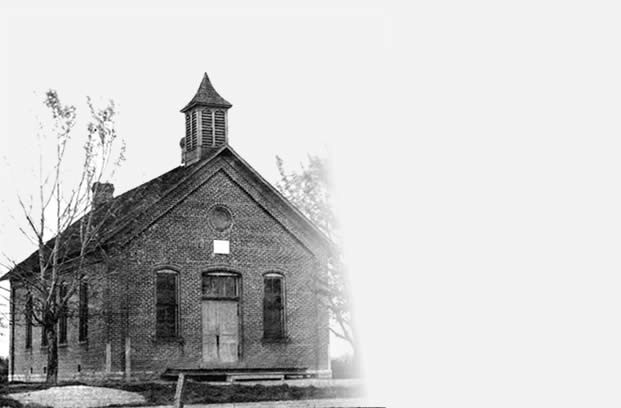

Dr. H. E. Fledderjohan
(1855-1950)
Compiled August 20, 1989
For New Knoxville Heritage Center Museum Dedication
Dr. Henry E. Fledderjohann, born on a farm a few miles west of here, son of H.H. and Katherine Engel Wellman Fledderjohann, was the first of the local community boys to choose medicine as his profession. He graduated from the University of Pennsylvania in 1886 and after a brief practice at St. Marys came here when Dr. Zuelch left, being able to converse in the Low and High German and English, his success was unlimited from the very beginning. He has without doubt made professional visits into every home of the community.
—George H. Kattman
Centennial 1836-1936
I remember going into his three-room office which consisted of a waiting room, examining room and a medicine room. The medicine room was full of shelves of all sizes, colors and shapes. The medicine mixed for colds or other things was usually mixed with a cherry syrup so as to make the medicine taste good.
He would come out to the home in a horse and buggy with his little black bag. This black bag held wonders.
He brought us and many other babies into the world to see the first light of day.
He must have once made the remark “Een drüppen fen dütt und een Drüppen fen dat, meck eenigen aoln Döwel daut.” (“A drop of this and a drop of that will kill any old devil.”) It really has to be said in Low German so as to sound right. Anyway he had his jokes, loved his work and was ready to help anyone night or day.
It was said when business was slow he would hitch his horse to the buggy and ride out into the country going full speed as though there were an emergency. Sometimes it must have been, but maybe the horse needed exercise. It was also a good advertisement that there was a Doctor in town.
The Doctor would come to church on Sunday even though he would be late a few minutes. He went to the front and would sit in the second or third row on the men’s side.
He gave me and other young people a vaccination at one time.
He had the best Ivy Poison medicine. I still know of one person who takes a dose of this medicine before he will go out to pick wild berries.
In his way he was a jolly, strict or sometimes funny fellow. That was old Dr. Fledderjohann we would say.
—Lenora Clausing
Dr. Fledderjohann gave me some Ivy Poison medicine that really helped. I still have two bottles of medicine for future use. I got the medicine from Zella Eversman.
—Mrs. Norman Katterheinrich
I remember when all the school children had to be vaccinated for small-pox. All the children who went to Dr. Fledderjohann had a round vaccination mark and the ones who went to Dr. Meckstroth had a rectangular shape. I lived in the country and a lot of the kids lived in town. So I thought the country kids went to Dr. Fledderjohann and the town kids went to Dr. Meckstroth.
My brother was intrigued how Dr. Fledderjohann knew just how far to pull the glass stopper out of his medicine bottles so the medicine came out in drops so he could count them as he put them in the prescription he was preparing.
—Mrs. Howard Kuck
Dr. Fledderjohann gave me red medicine for stomach ache.
—Abner Kattman
Dr. Fledderjohann treated me for Ivy Poison.
—Oliver Vordermark
I was sent to Dr. Fledderjohann to have a tooth pulled which my father was unable to pull. When the tooth was out I asked him how much I owed him. Instead of me paying him he gave me 25 cents for being a big girl and not crying.
I also remember that he walked around with his granddaughter.
—Mrs. Oliver Vordermark
I was scared of Dr. Fledderjohann when I went to him as a patient when I was a little girl.
He told his patients, “If you don’t do what I tell you, then don’t come back.”
He whipped his horses quite a bit because he wanted them to go faster. His father-in-law didn’t want to ride with him because he was afraid. Then he said, “Whoa,” and he could get out if he wanted to, but I don’t know if he did.
He would not let anyone in his room where he was mixing his medicine.
He had good medicine for Ivy Poison.
—Araminta Thieman
Dr. Fledderjohann treated me for pneumonia and vaccinated me for small-pox. I always bought Ivy Poison Medicine from him. Later I bought the medicine from Zella Eversman.
—Silas Lammers
Dr. Fledderjohann delivered my Mother in St. Marys. He drove over with a horse and buggy and went very fast.
—Lue Hoge
When I, Margaret, was a little girl between 4 and 5 years of age I had the whooping cough in the summertime. So my parents took me to Dr. Fledderjohann. He made me stand on his table in the waiting room and listened to my chest. I was not very happy to do this because I was afraid of him, especially his mustache and his stern look. But I tolerated it and I didn’t cry either.
Dr. Fledderjohann always took a walk in the country and had his cane with him. He usually came by my home and he called it the “Triangle.” I don’t know exactly what this included but I suppose from his office it would be going down State Route 219, then by my home and east down Holtkamp Road to Route 29 and then on to his home.
—Margaret Henschen
I remember when my parents (Raymond and Irene Fledderjohann) took me to see the Doctor. He would put me on his knee and always say “Just sit real still. I won’t hurt you.” But this was in Platt Deutsch which sounds much better to those of us who understand it and speak it.
—Evelyn (Fledderjohann) Sudman
Dr. Fledderjohann gave my Mother, Sarah Maneke, some medicine for her throat. She took it like he prescribed but it didn’t seem to help. So she doubled the dose and had to go back to the Doctor. It was a good thing she went back and he told her she could have burned her throat.
—Louisa Schrolucke
When I was a little girl Dr. Fledderjohann pulled a tooth for me. When I asked him how much I owed him he said, “Ten cents.” I gave him a quarter but he couldn’t make the change. So he gave the quarter back to me and said I could have it for being a “good girl and not crying.” How about that?
—Matilda Elshoff Kuhlman
Remembrances of Dr. Fledderjohann
- His medicine rack of all different drugs.
- A unique medicine mixer. Having the sugar base ready, pouring this in a bottle, then he would add the drugs, drop by drop from a height and never miss the mouth of the bottle.
- Noted for his poison ivy remedy.
- Was cruel to his horses. He whipped them to extremes.
- In his late years he did extensive walking around the town.
—Lenora Gritzmaker
The following article was written by Fred Katterheinrich and published in “Our Times,” New Knoxville Sesquicentennial Book 1836-1986:
Our Doctors
The Knoxville doctors were Dr. Henry E. Fledderjohann and Dr. C.E. Meckstroth. Dr. Fledderjohann had trained in homeopathy in a Philadelphia school and Dr. Meckstroth in Starling Medical at Ohio State.
Homeopathy was developed primarily in Germany in the previous century and is a medical science with some surprises. Briefly, a medicine may contain some very small amounts but strong ingredients that may cause symptoms of illness to occur in the healthy but can cure the afflicted. Dr. Fledderjohann had a clientele from far and wide for a special cough syrup and also an internal medicine for ivy poisoning. He reached his nineties and was a lively old man with a twinkle in his eye. Dad would have me fetch some cough syrup from this doctor who had delivered him and I would be entertained by the delight he took in his steady hand as he filled a narrow-necked bottle with a thread-thin stream and miss never a drop! He would extend the pouring distance to three feet or more. Since “de aolle Doktor” would be constantly moving about from shelf to shelf of reagent bottles and “heaven only knows what” and would constantly recite his actions and steps aloud as he was performing his ritual of medicine making, he would be saying the words that will forever remain famous about this old New Knoxville Doctor—“Een drüppen fen dütt und een Drüppen fen dat, meck eenigen aoln Dowel daut.” (“A drop of this and a drop of that will kill any old devil.”) Should he be interrupted by the phone he would answer it with, “Dütt is de aolle Doktor.” (This is the old Doctor.)
My grandmother Wierwille could never quite accept the rough talk she got from Dr. Fledderjohann while she was giving birth and things were getting complicated to the dangerous point. At that moment, Grandma said, “Doktor, ick kann et nich mehr stähn” (Doctor, I can not stand it anymore”) to which the old Doctor replied, “Mensch, dat is je nichs! Dat kannst Du noch eenmal sau stahn!” (“Woman, that is nothing yet. You can stand again as much.”) My grandmother became very angry at such an unsympathetic retort. She did not understand the thanks she owed to the old Doctor for a natural shot of adrenaline at a critical moment.
The following article was written by Fred Katterheinrich and published in “Our Times,” New Knoxville Sesquicentennial Book 1836-1986:
Another time, my aunt was dying in childbirth and my uncle had to rush into town by horse to get the old Doctor since no phone response was possible through Central at that late hour of the night. After Doc returned from this call, he stopped by Ben Cook’s store and threw a rock through the Telephone Central window on the second floor. The next morning, authorities were gathered there to apprehend the culprit that threw a rock through the Central window. Old Doc came by and asked about it and they told him they were after the person who threw the rock through the window up there. Old Doc said, “I am the one and do you press this point further with me, the responsibility for the death of a woman will summarily become your responsibility.” That ended any further concern about the broken window.
One Saturday when I was seven years old my eye hurt very badly. But my Mother said we couldn’t go to town until evening because Papa was out in the field with the horses and then we could also get the groceries. So I suffered with excruciating pain all day. So in the evening Papa took us to town in the horse and buggy and stopped at Ben Cook’s store. My Mother and I walked to Dr. Fledderjohann’s office. There was no patient there so the Doctor took us in his office right away. The Doctor checked my eye and there was nothing in it. So he gave me a “sprützen” (shot) in the eye. The pain was gone at once and it never bothered me since. I was forever grateful to Dr. Fledderjohann for his services.
—Amelia Conradi
—Compiled by
Selma Katterheinrich
New Knoxville Historical Society
August 17, 1989
The following story was related to Woody Hoge by Zella Fledderjohann Eversman:
“The wall light in the North bedroom was over “Doc” Fledderjohann’s iron bed. He was a large man and in later years had back trouble. He couldn’t bend easily, so to get in bed he would stand beside it and then jump up, landing flat on his back. Over the years the iron bed legs would dig into the floor. There were several plate patches where the bed had to be moved on to prevent it, and him, from breaking through the floor.”
—Woody Hoge
I remember when I was in the seventh or eighth grade I had a runny nose and a lingering cough. I went to Dr. Fledderjohann’s office on a Sunday afternoon. He explained to me how he won a lawsuit in Toledo. He was charged for illegal use of drugs. He defended himself by using his Bible. He told me how the Judge declared him “Not Guilty.” He then mixed up a big bottle of medicine and it cured my cough in several days.
—Arnold Katterhenry
Atlanta, Georgia
When Dr. Fledderjohann was in his nineties and was nearly blind he would walk by our house (Attorney Tom Katterheinrich’s house now) at noon. He would tap his cane until he came to the place where there was an offset in the sidewalk. I would visit with him for a few minutes then. I learned two things from him. One was that if you come to a place with an angry dog just look the dog straight in his eye. Keep up backing slowly and you will get away. The other thing was that if the Doctor knows you personally and you believe in him you will get well sooner. Sometimes the Doctor will just change the color of the medicine.
—Oliver Hoge
My Dad, Wm. L. Hoelscher, was Dr. Fledderjohann’s first patient. When told to open his mouth, he took out his tool that had a wire on it, and jerked the tonsil out. (We have two tonsils.) Then he said, “I believe that will do it.”
—Myron Hoelscher
AS I REMEMBER
Dr. Henry Fledderjohann
By Arnold W. Meckstroth
I am glad to identify with Dr. Henry Fledderjohann and his family. My grandmother, Mrs. William Meckstroth was Elizabeth Catherine Fledderjohann (b. 1846) and her brother Frederich Heinrich Fledderjohann (b. 1848) were the “two-Fledderjohanns” in the family that survived in the 1849 cholera epidemic.
My grandmother, born Elizabeth Fledderjohann, was the daughter of Herman Wilhelm Fledderjohann (b. 1824) and the granddaughter of Heinrich Herman Fledderjohann (Sr.) (b. 1786), who with his wife and four children, 3 sons and 1 daughter, migrated to the New Knoxville area in 1835 from Ladbergen, Prussia (Germany).
In this context my grandmother Elizabeth Meckstroth, nee Fledderjohann, was a cousin of Dr. Henry Fledderjohann since Henry was the son of Heinrich Herman Fledderjohann (Jr.) (b. 1816), the older brother of Elizabeth’s father, Herman Wilhelm Fledderjohann (b. 1824).
I was the son of Benjamin Lewis Meckstroth (b. 1871), who was one of the sons of William and Elizabeth (nee Fledderjohann) Meckstroth and was born to Benjamin and his wife, Anna, nee Maneke, (b. 1876), in 1909 on a farm nearly two miles west of New Knoxville.
It was natural for our family to look to Dr. Henry Fledderjohann as its family doctor for many years, although when I was born in 1909, “the role of the stork” was played by Dr. Henry’s brother, Dr. Ferdinand Fledderjohann of nearby New Bremen, Ohio.
Just a few personal incidents related to Dr. Henry Fledderjohann:
As a doctor he issued his own medicine. At one time he prescribed a medicine for one in our family. The bottle of medicine was placed in a cabinet out of my normal reach. Being curious, with the help of a chair, I reached for the bottle of medicine and tasted it, and it tasted “good,” good enough, that I drank all the medicine in the bottle. My mother learned of this and became excited and disturbed. She immediately called Dr. Henry but he assured her that the medicine would not harm me. However, I learned my lesson not to do this again.
I have a permanent scar on the left side of my upper lip. It being there reminds me of Dr. Henry. I was a young lad, 9-10 years of age, when an accident occurred on our farm. My father was at work cleaning the manure and old straw from the chicken stable. The manure spreader was outside of the chicken stable door with my father, using a scoop-shovel, to throw the manure on the manure spreader. He was hard at work when I ran in between the spreader and the chicken house, entering the chicken house door just at the time when my father was throwing a shovelful of manure on the spreader. One corner of the shovel hit me on my upper lip.
Immediately my father and I became aware of this unfortunate accident and the bleeding related to it. All work was stopped, my father took me and we rushed to the automobile (it was a 1916 Ford) and we were on our way to Dr. Henry. This was one time that I saw my father drive the auto faster than at any other time. He always was a cautious driver. When at Dr. Henry’s office he gave me immediate attention and said it was not serious enough to require any stitching; so he used adhesive to pull the gaping edges together. All went well with the healing process; the scar remains; frequently in the years past I have been asked by others whether I had had a hair-lip. There were a few times since this accident that Dr. Henry would “have a look” at my “lip” and a few times he did say, “if I had stitched the lip there probably would have been no remaining scar.”
In my growing-up years, I like many others would meet Dr. Henry at his home area or on the street, since it was so near to the high school. I, too, regarded him with great respect and appreciation, for he had become a special person for our community and its people.
I join with many others in being grateful for his life, mission, and memory.
—Arnold W. Meckstroth
MY MOST UNFORGETTABLE CHARACTER
My first association with Dr. Henry E. Fledderjohann (B: 1855 – D: 1950) was one of which I was completely unaware. When my arrival into this world became imminent Doc was sent for with the usual urgency, for I have been told that Father had to drive in and bring him out to our farm that was three miles from the village. Evidently he did not yet own a buggy and one of the very fast horses for which he was well known during my childhood years. Dr. Fledderjohann was born and reared on a farm in our community and after finishing what schooling he was able to get in those early days, taught in a country school. He was my father’s teacher and a more exacting teacher probably never taught the 3 R’s in that school whereas in most other schools of those days many of the pupils were as old as the teacher.
School must have been anything but monotonous, for he was an excellent storyteller, embellishing his tales with the most exciting details; partially a product of his own imagination. After two years at Pennsylvania Medical School he received his diploma and came back to his home community and hung out his “shingle” by the very same door where it hangs today. Although by now the letters have become faded and it hangs somewhat askew. He quickly gained the reputation of being a brilliant physician and a very generous person. He kept no records of money owed him and sent out no bills to collect fees. He had need for a fast horse in those days and indeed he had them. Usually they were high-spirited creatures from which other people kept at a safe distance. About every three years he bought a yearling colt which he farmed out until such a time as he needed it. The farmer fed and cared for it and helped him break it to the harness and drove it until “Doc” needed a new horse. At one time my father had one of these wild creatures of his, and after it had been tamed and broken my older brother used it to carry on their “courting,” until the time came that he [Doc] had used and abused his older horse enough to wear it out.
About ten years after his marriage his wife passed away leaving three young children to rear, a son and two daughters, one of whom is a brilliant musician, Zella. The “Doc” never married again and no doubt that lack of wifely companionship contributed a great deal to a life full of contradictions. As he neared the fifties he began to drink quite heavily and neglected his practice with the result that people lost confidence in him. He loved to fish and it was during this period of his life that he turned this much loved form of recreation into a game of law evasion. He would go out at night and place nets in the lake not many miles away. If he caught more fish than his family could eat he distributed them among his patients. For a long time the fish and game warden suspected him of carrying on this activity but could never find any evidence against him. I have heard him tell about the time that the wardens searched his premises and felt absolutely sure that he had nets concealed somewhere, as indeed he did have. “And where do you think they were?” he said gleefully. “Why all the time the men were searching the place I was standing right over them. I had them hidden in the cistern and was standing on the stone slab cover.”
He lived across the street from the village school and when the ball landed in Doc’s yard there would be no angry comments or keeping the ball as some of his neighbors invariably did. When a youngster needed a tooth pulled he was ready to step into the field of dentistry with the admonishment of, “It won’t cost you a cent if you don’t cry, but if you do, it’ll be a quarter, sir.”
As time went on he turned from drink to narcotics, and to being able to account for all the narcotics he supposedly dispensed, federal agents were sent out to investigate him. He was brought into the federal district court but since the court could not find enough evidence against him he was released, and just to show the lawyers that he was not in the least frightened he poured a bottleful of medicine into an empty bottle which he held two feet below without spilling a drop.
Then for a while he went back more or less to his former temperate self and became absorbed in the invention of a turbine engine. When he had it perfected he went to Germany to bring his invention to the attention of the German scientists and Kaiser Wilhelm. He was granted an audience with the Kaiser but it seems as though the German scientists were a step ahead of him with regard to turbine engines, and came scurrying home again to avoid being detained in Germany at the outbreak of the WWI. Then for many months when he called on patients, everyone had to listen to his lectures on the “hunstlichen diiger,” commercial fertilizer as we know it, which had just been formulated by German chemists. It involved the process of taking nitrogen from the air and he recognized it as being a great contribution to science.
He had an exasperating habit of talking and talking about anything and everything before he attended to his patient but he was a much wiser man than many people realized.
Written by Ella Wellman Schroer – B: 1902 – D: 1990, in the early 1950’s as a theme paper for her teaching degree.
A Poem About Doctor Fledderjohann
by Matilda Kiefer
Although the following poem was not a part of the original “Remembrances of Dr. Henry E. Fledderjohann” booklet compiled by Miss Selma Katterheinrich in 1989, it fits in with the things people remembered about Dr. Fledderjohann. This poem, titled just “Doc” was written by Mrs. Matilda Kuck Kiefer, a lifelong resident of New Knoxville from 1905-1976. A collection of Mrs. Kiefer’s poems may be found as an appendix in the latest spiral-bound reprint of the 1936 New Knoxville Centennial book, which is available at the NK Historical Society Heritage Center or on our website.
DOC
Among the fellow citizens
Of our small town,
Was an old country doctor
Known for miles around
His face wore a mustache;
I remember it well;
And his eyes how they twinkled
When a tale he would tell.
His office wasn't fancy,
Just chairs along the wall,
With ivy in profusion
Climbing over brick and all.
He drove a horse and buggy
The countryside around,
Calling on the ailing folks,
Nearby and all around.
For the itch of ivy rash,
The doctor found a remedy.
For medicine to cure a cold,
He was the man to see.
He'd pour liquid from a bottle,
And then much to our surprise,
It would slowly change in color
Right before our eyes.
In the porch swing ‘neath the branches
Of a large oak tree,
The doctor oft would sit
And swing contentedly.
With cane in hand at even’ time
The doc we’d often see,
Walking slowly to the ball park,
A baseball game to see.
In Germany Doc saw the
Famous Passion Play,
And then on his return
He spoke in school one day.
We sat with rapt attention;
I remember it now,
As he told to us the tale
Of Oberammergau.
In later years the Doctor
Took a walk most every day,
And often he would pause to chat
With friends along the way.
At the age of ninety years
One day, the doctor said to me,
"I must be getting old;
My memory's failing me.
When I was in the hospital
Friends came to call on me,
But seems I can’t remember
Who all these folks might be.”
Well, Doc’s no longer with us;
A faithful friend was he,
But the old brick office still remains
For passers-by to see.